Views: 0 Author: Site Editor Publish Time: 2026-08-18 Origin: Site
Purchasing materials for signage or displays often triggers a frustrating dilemma. Buyers must constantly choose between the low per-square-foot cost of raw 4x8 sheets and the high convenience of pre-cut custom sizes. This choice heavily impacts your overall project budget and timeline.
Many project managers only look at the initial sticker price of raw materials. They frequently forget to calculate shipping variables, waste factors, and manual labor implications. These hidden expenses often transform a seemingly cheap bulk order into a massive budget drain.
This guide compares material costs, freight constraints, and factory yield limitations. We provide a transparent framework to help contractors, event planners, and business owners decide the best procurement route. You will learn exactly how order volume and application dictate your true landed costs.
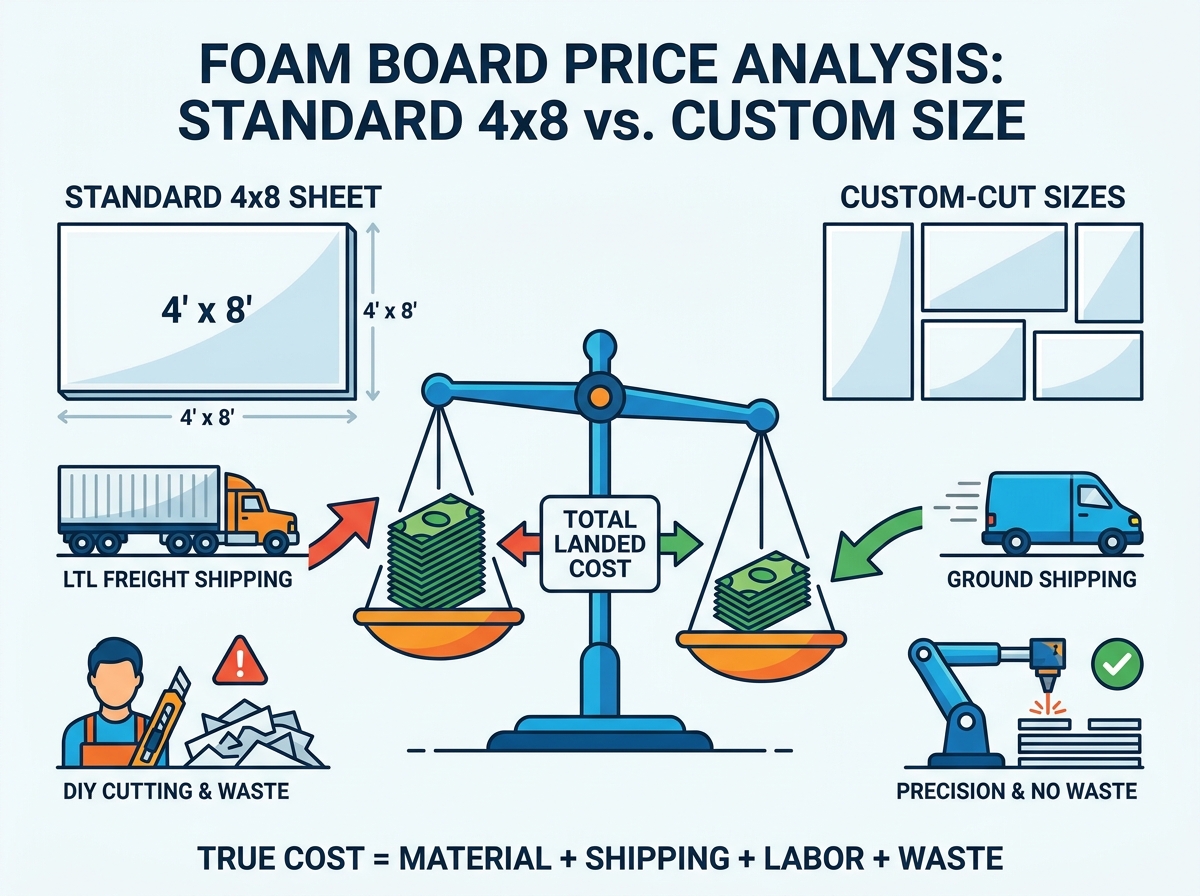
The raw foam board price per square foot is significantly lower for standard 4x8 sheets, but Less-Than-Truckload (LTL) freight shipping can immediately erase these savings for low-volume orders.
Custom-cut boards carry a premium for CNC routing and handling, but standard ground shipping and zero on-site waste often make them cheaper for specific, repetitive dimensions.
True cost evaluation must include labor (DIY cutting time), edge-finish requirements, and minimum order quantities (MOQs).
Material type (e.g., paper-faced foam core for signage vs. extruded polystyrene/XPS for insulation or terrain) drastically alters the baseline pricing model.
Every accurate cost analysis begins by examining raw material production. Standard large-format sheets set the baseline for all subsequent pricing models in the industry.
Bulk manufacturing relies on standardized sizing to maximize factory output. Producing continuous 4x8 sheets ensures production lines run without interruption. A standard 4x8 board yields 32 square feet of usable material. Factories pass these efficiency savings directly to the buyer. Therefore, the baseline foam board price for an uncut sheet will always look incredibly appealing on paper. Bulk distribution centers stack these sheets onto large pallets, moving massive volumes efficiently. If you purely evaluate material per square foot, standard sheets win every time.
Different applications require different core materials. The internal makeup of the board shifts your starting price tier significantly.
Standard paper-faced foam core represents the cheapest tier. It works perfectly for short-term indoor signage. Gator board sits in the mid-tier. It uses wood-fiber veneers for added rigidity and moisture resistance. Finally, extruded polystyrene (XPS) and expanded polystyrene (EPS) serve as rigid insulation boards. These application-specific materials command different baseline rates.
Material Type | Relative Price Tier | Primary Application | Durability Profile |
|---|---|---|---|
Standard Paper-Faced | Low | Indoor signs, crafts, presentations | Prone to denting, not moisture resistant |
Gator Board / Veneer | Medium | Long-term displays, photo mounting | High rigidity, moderate moisture resistance |
XPS / EPS Rigid Insulation | Varies by R-value | Construction, terrain building | Highly durable, excellent thermal resistance |
Shipping oversized goods introduces the biggest budget shock for new buyers. A single 4x8 sheet costs very little. However, shipping it requires a freight truck. Standard parcel carriers like UPS and FedEx reject 4x8 dimensions. Less-Than-Truckload (LTL) shipping imposes hefty minimum base rates. A small order of five boards might carry a $150 to $300 freight bill.
You must buy in bulk to dilute this freight penalty. Pallet pricing spreads the delivery fee across 50 or 100 sheets. Alternatively, local pickup eliminates freight entirely. Securing standard sheets from big-box hardware stores or local sign suppliers keeps standard sheet pricing viable.
Raw 4x8 boards demand specific facility requirements. You need large, flat storage racks in climate-controlled environments. Leaning 4x8 sheets against a wall causes bowing over time. Furthermore, moving massive boards around a tight warehouse increases the risk of edge-crushing. Damaged corners ruin the usable yield of the board.
Pre-cut boards look more expensive initially. However, you pay for specialized services and logistical shortcuts. Understanding these premiums helps you justify the higher unit cost.
Factory-grade CNC (Computer Numerical Control) cutting guarantees dimensional accuracy. Humans make mistakes; machines do not. You pay for precise tolerances. When you need a board to fit perfectly into an extruded aluminum frame, a one-millimeter error ruins the display.
Consistent Replication: Factories cut hundreds of boards to identical dimensions.
Square Angles: Machine cuts guarantee perfect 90-degree corners.
Clean Passes: Proper factory blades prevent core crushing during the cut.
High-end signage, event backdrops, and frame inserts demand exact tolerances. You secure peace of mind by paying this premium.
Custom sizes drastically alter shipping logistics. If you order boards cut to 24x36 inches or smaller, they fit into standard parcel network dimensions. You bypass LTL freight entirely. Standard UPS or FedEx ground shipping costs significantly less than freight. Moreover, you avoid residential freight delivery surcharges and liftgate fees. For mid-sized orders, the savings on shipping often completely offset the premium paid for custom cutting.
Custom orders rely on scaling logic. Custom-cut providers must program the CNC machine, load the material, and run test cuts. This setup time costs money. Therefore, suppliers often require Minimum Order Quantities (MOQs). Custom cutting is rarely cost-effective for a single small board. You essentially pay the setup fee whether you order one piece or fifty. As you increase the volume, the setup fee dilutes, making custom sizes highly economical for bulk identical pieces.
Choosing standard boards assumes you will cut them yourself. This assumption introduces severe hidden costs. Manual processing rarely goes exactly as planned.
Internal labor carries a steep hidden cost. Consider the time required for an employee or hobbyist to process raw sheets.
Clearing a massive workspace to lay out the 4x8 board.
Measuring and marking precise lines across long distances.
Positioning a heavy straightedge and clamping it down.
Scoring the face paper multiple times.
Snapping the core and slicing the bottom paper backing.
If an employee earns $25 per hour, and it takes 20 minutes to properly process one sheet, you just added over $8 to the true cost of that material. DIY cutting time destroys budget efficiency on large projects.
Yield determines your actual material efficiency. We call this nesting logic. Suppose your project requires 30x40 inch boards. You can only cut one 30x40 piece from a standard 48x96 inch board. You leave massive strips of unusable scrap behind.
If your required dimensions leave 30% of a board as unusable scrap, your effective cost per usable square foot increases proportionally. You pay for material you simply throw in the dumpster. Factory custom cuts optimize yield across hundreds of sheets, ensuring you only pay for the exact square footage you need.
Manual cutting introduces significant quality risks. Dull utility knives tear the paper facing. Uneven pressure compresses the delicate foam core. A slipping straightedge ruins the entire board instantly.
Reworking jagged edges wastes even more time. You might need to sand edges or apply edge-banding to hide mistakes. Factory cuts deliver pristine, clean edges. They require absolutely zero post-processing. A clean edge elevates the professional appearance of your final product.
Your specific industry and project goals dictate the best procurement strategy. The optimal choice changes based on how you use the material.
These applications place a high priority on aesthetic finish. Displays sit at eye level. Guests notice jagged edges immediately. Furthermore, boards must fit specific easel dimensions or pipe-and-drape frames. There is zero margin for error.
Verdict: Custom-cut usually yields better ROI due to zero margin for error and pristine aesthetics.
Contractors and hobbyists building large structures prioritize maximum volume coverage. Walls and terrain layouts consume massive square footage. The aesthetics of the cuts matter very little because drywall or modeling clay hides the edges entirely.
Verdict: Standard 4x8 sheets purchased locally yield the best ROI.
National retail campaigns require exact replication across dozens of store locations. A POP display must look identical in New York and California. Brands also need efficient direct-to-store shipping logistics. Mailing bulky 4x8 sheets to individual stores is impossible.
Verdict: Custom-cut bulk orders win on consistency and direct-to-store shipping logistics.
Choosing the right procurement path requires a logical evaluation of your specific constraints. Use this shortlisting logic to guide your purchasing strategy.
Choose Standard 4x8 if: You have strong local supply channels to bypass freight costs. You have high overall square footage needs. You possess the internal labor, large cutting tables, and professional tools to cut efficiently. Finally, you should choose standard sheets if your final edges will be framed or hidden from public view.
Choose Custom Sizes if: You require dimensions well under 48 inches. You lack access to commercial freight docks. You require pristine, exposed edges for high-end presentations. You need 50 or more identical pieces where manual measuring and cutting would stall your production schedule.
You can determine your exact tipping point using a simple conceptual formula. You must compare the landed costs of both methods.
Calculate Route A (DIY):
(Cost of standard 4x8s) + (LTL Freight or Truck Rental) + (Internal Labor Hours) + (Value of Wasted Scrap)
Calculate Route B (Factory Pre-Cut):
(Cost of Custom Boards) + (Standard Ground Shipping)
Run your specific numbers through this formula. If Route A exceeds Route B, you should immediately switch to custom sizes. For more personalized pricing assessments, you can always contact us directly to evaluate your project needs.
Finding the lowest sticker price on a 4x8 sheet rarely equals the lowest final project cost. Ignoring freight constraints and labor realities usually leads to massive budget overruns. Standard sheets offer unbeatable volume value for local buyers and heavy construction applications. Conversely, custom-cut boards eliminate waste, guarantee aesthetic perfection, and unlock cheaper parcel shipping rates.
We encourage all buyers to run a pilot calculation before ordering. Check your specific zip code for freight constraints. Map out your exact yield on a piece of paper to expose hidden waste factors. By analyzing these variables upfront, you secure the best possible value for your material investment.
A: Yes, thickness drives cost significantly. The price jump from a standard 3/16-inch board to a rigid 1/2-inch board is non-linear. Thicker boards require more raw material and longer curing times during manufacturing. Always buy the minimum thickness your rigidity requirements allow to keep costs down.
A: Less-Than-Truckload (LTL) base rates usually start around $150 to $250, regardless of how light the boards are. Freight companies charge for the oversized space the pallet occupies. Residential deliveries or locations requiring liftgates often trigger additional $50 to $100 surcharges.
A: The industry relies more on setup fees than strict MOQs. You can often order a single custom piece, but you will absorb the entire $30 to $50 CNC setup fee. As you order more units, this flat setup fee spreads out, dropping the cost per board dramatically.
A: Yes. Standard white boards feature the lowest manufacturing cost. Black core boards, or boards with specialty black paper faces, carry a raw material premium. The carbon dyes and specialized paper layers required for true black finishes generally increase the base price by 15% to 30%.